
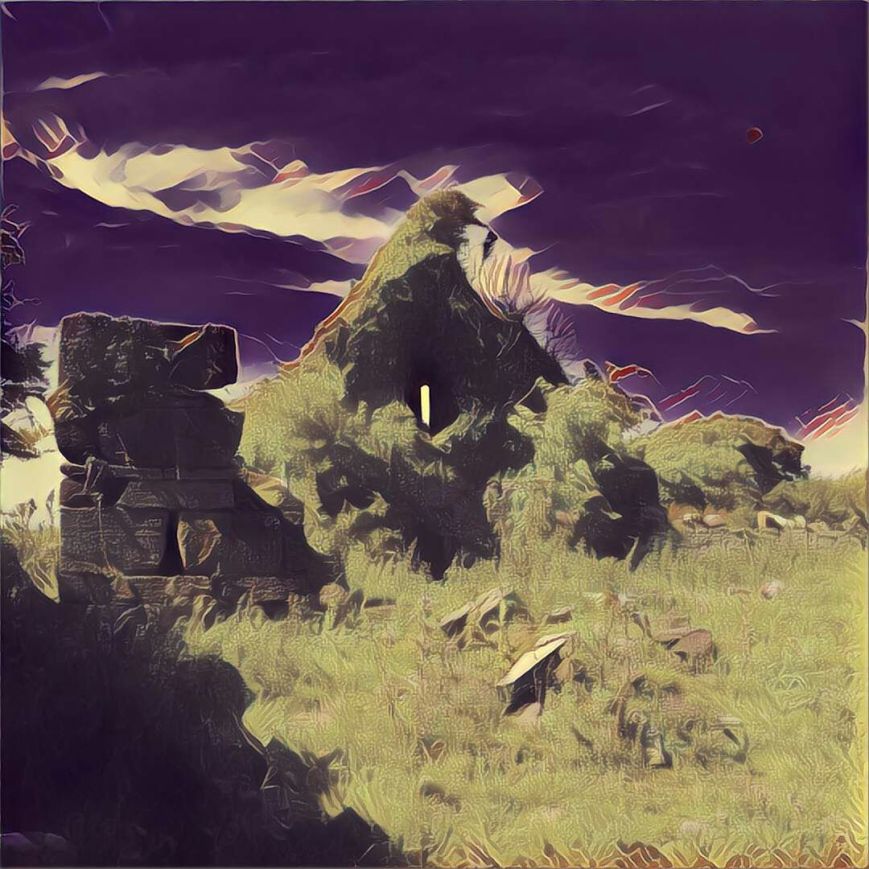
Inishdaff, Co. Mayo (Image: Author)
Forgive the pedestrian nature of this post, but I feel compelled to undergo the annual ritualistic Rear View, Year Review Mirror escapade – if nothing else – at least in the hope that it will help hurry the end, underline, and perhaps cement, what will surely be remembered worldwide as an annus horriblis.
Despite having a relatively quiet year here on Vox Hib, my little niche blog has somehow managed to continue breaking previous records. 2016 was my most widely received year so far. I am, as always, most grateful. Thanks a million for reading and/or sharing.
For what its worth, here’s some boring stats. The previous majority European readership for the blog has, for the first time, been eclipsed by North America. Top five regions for 2016 were: The US, Ireland, The UK, Canada and Australia. Highest number of non-English speaking regions were Germany, France, Netherlands, Spain and Belgium. A special shout out to those peeps in Uzbekistan, Kyrgyzstan, Turks and Caicos Islands, Côte d’Ivoire and Guam.
I used to do this elsewhere on social media, but have decided to present here instead – a selection of some of my favourite obscure/funny/wtf search terms with which some people found their way to the blog in 2016: (No, I have no idea, either) –
- can you hear me now irelands ancient east
- in ireland munster are stones who are bleeding red?
- viking leather pants found in grave site
- difference between rural horror and folk horror
- would brigid the goddess mind being a catholic saint
- psilocybe semilanceata
- psilocybe in ireland
- 10th century irish propaganda two guys mooning
- medieval word for a wedding trunk
- submissive wanted in mayo
Ladies, gents, bots. Wherever you are. I salute you.
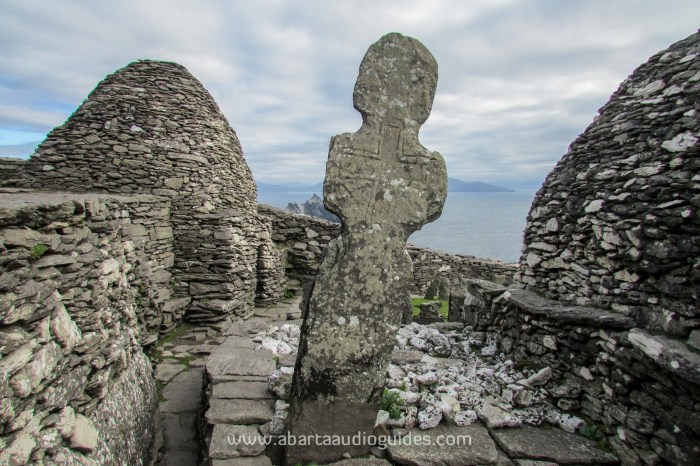
Image: Abarta Audioguides / Copyright (Used with permission)
In terms of highlights, 2016 started off with a bit of a blog hangover from 2015. Last Christmas, to tie in with Star Wars: The Force Awakens, I dashed off a little thing about the (Early Medieval) Archaeology of the Jedi – i.e. the use of Skellig Michael as a key location in the film. It turned into a mini viral hit and continued to be updated until April or so – resulting in a January follow up on The Conversation UK: ‘The remote Irish monastery where medieval Christianity meets fictional Jedi spiritualism’.

Image: amandabhslater / flickr (CC BY-SA 2.0)
In February, fed up with the annual ‘celtic’ codswallop about Imbolc, I wrote this piece: ‘Never Mind the Bullocks: There’s Something About St. Brigit’, in which I hoped to illustrate her actual importance and context within Early Irish hagiography, and also perhaps, some of the very real things her increasingly popular cult probably displaced.

Image: Emmet Ó hInnéirghe (Used with Permission)
In March, my annual patrician extravaganza focused on some lesser spotted, but nevertheless important, details contained within the Historical (St.) Patrick’s own account of his Escape from Slavery and subsequent Journey Across Ireland.

Image: TechnoHippyBiker / Flickr (CC BY 2.0)
Still feeling somewhat enthused from the whole Star Wars thing, my annual April First post went out on a limb with the zeitgeist. ‘Disney To Enforce Star Wars Copyright of Skellig Michael For Next Ten Years’ managed to both amuse, and apparently fool, many an unwitting reader. So much so, its probably my most read and shared post of the year – something which sadly suggests that I’m in the wrong business. It actually continues to reap hits. Only last month it was shared by a minor US tech celebrity (with 2 million twitter followers) as well as the director of a fairly big digital creative agency.
Whoops. #SorryNotSorry
In June, I went on my annual expedition to the Island of Inishark, as part of the Cultural Landscapes of the Irish Coast Project (CLIC) – where I had the privilege of partaking in the excavation of a stunning early Medieval Pilgrimage site which contained more quartz pilgrim pebbles than has perhaps ever been uncovered, anywhere in Ireland.

This was followed up in early July with a panel presentation on same (with colleagues Elise Alonzi and Ryan Lash) at the 2016 Irish Conference of Medievalists at Maynooth University where I concentrated on illustrating some of our work on ArcGIS. Essentially, attempting to show a synthesis of archaeological, onomastic and folklore data on a scrollable, zoomable interface.
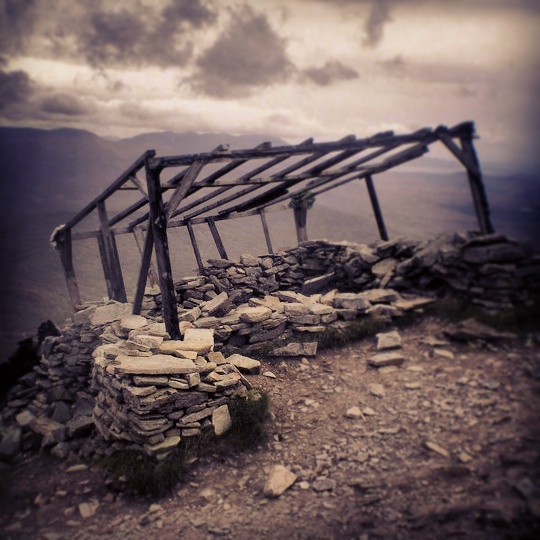
In late July, I turned my attention to the annual patrician pilgrimage in Co. Mayo. ‘On Eagles Wings’ – Croagh Patrick: The Mount Sinai of Early Medieval Ireland’, was an attempt to place the location in its earliest historical and hagiographical context, as well as offering some views as to how the annual excursion may be managed in the future.
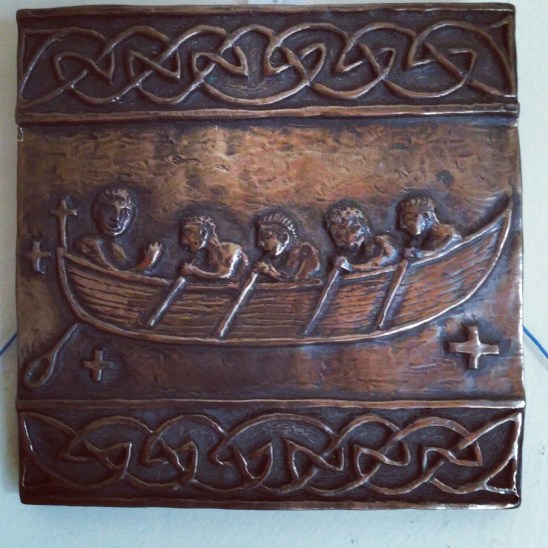
Bronze replica of the ‘Bantry Boat’ depicted on the Kilnaruane Cross Pillar, Co. Cork (Image: Author)
In August, I waxed lyrical about the beauty and privilege of having the opportunity to engage in a quasi-pilgrimage of my own. ‘A Modern Day Immram in Ireland’ detailed my hopes and aims in heading out west in a two hundred year old (designed) boat, following in the footsteps of Early Medieval Monks. Despite bad weather and much alternative (emergency) planning, we did manage to row around Cleggan, Clew Bay and all the way out to Clare Island.

With the approach of Halloween in October, I took the opportunity of re-living some previous arcane and spooky shenanigans. ‘A Tomb With A View: Further Archaeo Adventures in Folk Horror’ was my seasonal offering, detailing some of the more stranger discoveries that can occasionally befall the unwitting archaeologist in Ireland. You have been warned.
Image: Pindoc / Flickr. (CC BY-NC-ND 2.0)
I finished off the year, perhaps appropriately, in rather grumpy fashion – with an occasionally potty mouthed tirade against Irish Metal Detectorists, or as I have been known to describe them as… sticky dick whistling, twatwaffling, shite-hawking, fuck tumpeting, piss plonking, cock juggling thunder cunts.
Don’t. Get. Me. Started.
*****************************************
An honorable mention goes to Dr. Elva Johnston’s ongoing (and soon to be finished) epic endeavor ‘Saints & Scholars: Tweeting Saints in Medieval Irish Martyrologies’. Although nothing to do with me, I have been collecting her monthly Storyfied content together in one post, for convenience sake. Due to be completed next month, links to all twelve months can be found above.
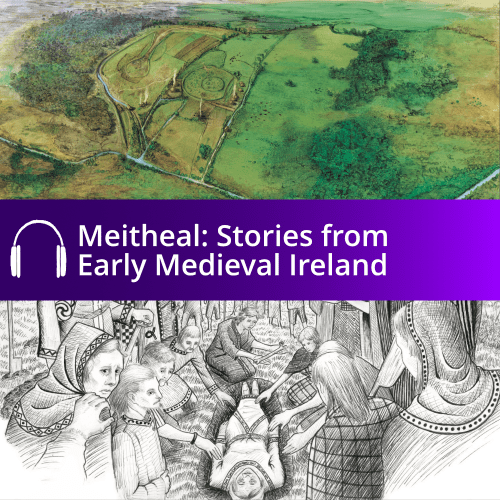
Image: Upper illustration is a painted reconstruction of Raystown in c. AD 900 by Simon Dick. Lower illustration is an artistic imagining of the burial of an older woman at Raystown by JG.O’Donoghue.
Lastly, I also had a small role in Abarta Heritage’s latest (and free to download) Audio Book ‘Meitheal: Stories from Early Medieval Ireland’ which dramatically brings to life the actual evidence recovered from the excavations at the important early medieval site of Raystown, Co Meath. (For more information see: Meitheal; The Archaeology of Lives, Labours and Beliefs at Raystown County Meath). I may be biased, but I really do think its a good way to expose people (especially students of all ages) to not only the rich archaeological data concerned, but also perhaps, some of the lighter and darker realities of the early medieval period in Ireland.
Now, I’m not *saying* there’s a hidden VoxHib Easter Egg contained within the above audio book…
But.
A Million Internet Points to anyone who can spot the in-joke.
****
Thanks so much again for reading and sharing in 2016.
Look on the bright side. 2017 can’t get any worse. Right?
 vox hiberionacum
’10th century Irish propoganda two guys mooning.’
Sadly I think I know what the answer may be to that one.
Dates wrong, its the picture of the chief of the Mac Sweynes seated at dinner from The Image of Ireland.
Feast of ethnographic detail including two farters who may be involved in some early form of pyrotechnic display.
LikeLiked by 1 person
I suspect you’re spot on, Jeb. Thought as much myself. Many thanks. Pyrotechnics. 🙂
LikeLike