1014 and all that

0

Image: seriykotik1970/Flickr (CC BY-NC)

Today marks the 1000th anniversary of the death of Brian Boru at the Battle of Clontarf on 23rd April 1014 AD. You would have to have been hiding under a rock in deepest darkest Antarctica to have missed out on the plethora of associated festivities, events and commemorations that have been taking place in Ireland over the last few weeks. As an early medievalist, it was quite refreshing to see so much attention and interest in the media and public gaze. Some highlights include the wonderful TCDs ‘Emporer of the Irish’ Exhibition, History Hubs excellent video series on the background and legacy of the battle, the Irish Times heritage supplement on the subjects involved, the Contarf 1014 Exhibition in the National Museum and the TG4 documentary ‘Cluain Tarbh’ (still available on their online player).

Amongst all the the historical interpretation, contextualization, national & local promotion initiatives, educational endeavors, harnessing of tourism potential and – lets be honest – some blatant attempts to cash in on some sexed up horny Viking action; there has been little attention on an underlying historical consequence that (although unrealized at the time) would go on to have far reaching ramifications. And so, as we come to the end of the main commemoration, I thought I would throw my two cent into the larger Boruhaha.

Continue reading

Ad Solis Victi Hibernicum: To the Conquered Irish Sun

IMAG0434

Setting Sun, Atlantic Ocean, Ireland (Image: Author)

Seeing as today is the summer solstice in the northern hemisphere, I thought I’d share the earliest contemporary historical reference to pagan Irish sun-worship which is found within Patrick’s Confessio, written sometime in the fifth century AD. It occurs at the very climax of the document as Patrick is signing off and declaring his deep Christian faith and belief in his ‘children of the living God and co-heirs of Christ’…

Continue reading

Rapunzel, Rapunzel, Let Down Your Hair: Rappelling Round Towers in Medieval Ireland

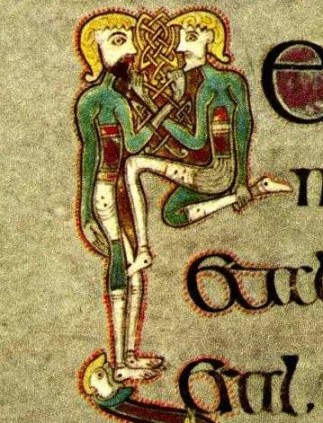
kells 253vThis is just a brief little ditty thrown together in haste –  in reply to a recent highly entertaining and thoughtful blog post by Robert M Chapple: ‘George and the Giant Archaeological Theory’. In it, he implies (somewhat alarmingly) that a) I am level-headed (slander, your honour!) and b) that I may somehow know something about monastic ‘rope-ladders’ in Ireland.

Sadly, I have yet to come across anything tangible involving rope ladders in either archaeology or hagiography, something which is only slightly lessened by my absolute devastation at the lack of early medieval pole vaulting evidence. (Confused? Read the original post.)

Continue reading

In the Name of Allah? Broaching Carolingian Connections at Ballycottin, Co. Cork

The British Museum’s Collection Database is a wonderful online resource containing over two million objects. It’s an incredible research tool in itself, for all periods and personages. Perhaps a lesser known aspect are some wonderful archaeological tidbits relating to finds from nineteenth century Ireland. Taking a virtual wander through the database one can stumble across some really intriguing objects, like this particular oddity from 1875; an early medieval Carolingian Brooch said to have been found in a bog at, or near, Ballycottin, Co. Cork.

AN00275809_001_l

Carolingian Brooch/Amulet (1875,1211.1) © The Trustees of the British Museum

Continue reading