
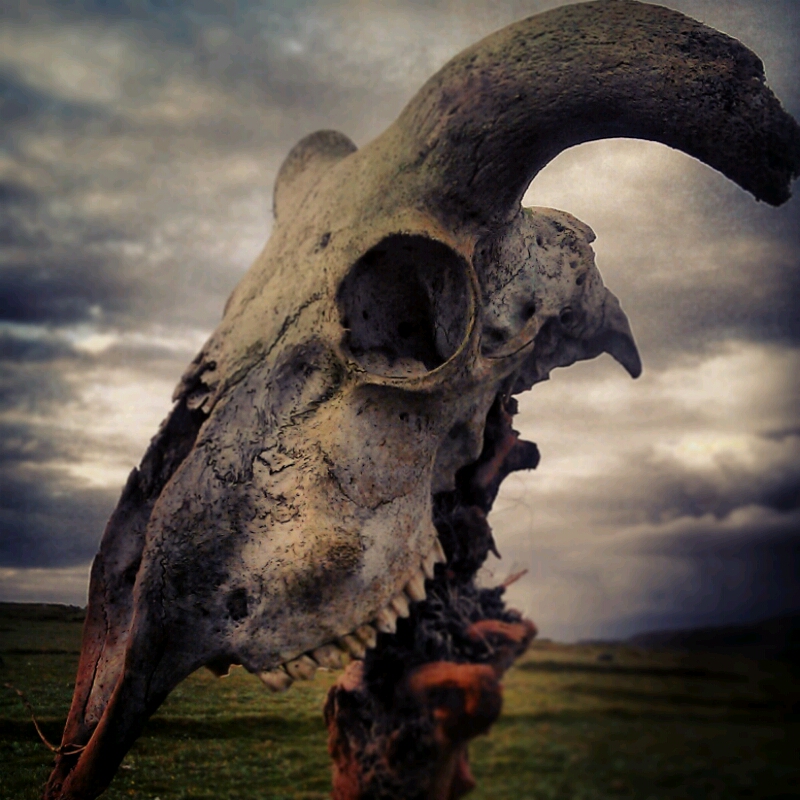
Skull of one of the only indigenous islanders left: sheep (Image: Author)
I’m just back from two weeks excavations on the deserted island of Inishark, Co. Galway, situated just west of Inishbofin – one of the most westerly outposts of Ireland. Next parish: Newfoundland. Since 2010 I have been privileged to be a team member of an annual archaeological and historical survey of the island as part of the Cultural landscapes of the Irish Coast Project (CLIC) led by Professor Ian Kuijt, Note Dame University. This years archaeological excavations were directed by Franc Myles, one of the most experienced (and funniest) field archaeologists in Ireland.
Inishark (Inís Airc) was once home to several hundred people at the height of its settlement during the 19th and early 20th century – which had sadly dwindled to just 24 islanders when it was finally evacuated on the 20th October 1960. Like many other islands, the famine and successive bouts of economic depression, poverty and emigration took its toll on the native population. It never had electricity, modern communication or running water and unlike many others, was completely isolated for weeks on end during bad weather and winds.
Despite the hardy nature of the islanders themselves – some of the best boat people in the country (they had to be – nine miles out in the North Atlantic Ocean) – their basic living conditions and lack of emergency medical attention were such that they were eventually resettled on the mainland. Their story, and that of the island is perhaps best known to Irish audiences from the fantastic TG4 documentary from a few years back –
Today, 50+ years after evacuation, the entire island is a relict landscape of a once vibrant community – now abandoned and ever so slowly being reclaimed by the earth. Field walls and stone houses stand in various states of dereliction; the lumps and bumps of lazy beds, turf racks and kelp kilns bear silent witness to the islanders self-sufficiency. Stones peeking out of the earth tell tales of eking a living from the earth. A frozen landscape, fossilized in time and space – slowly sinking beneath the weight of its own sad echos and the ever-present natural erosion from the merciless Atlantic Ocean.

 vox hiberionacum