
Image: Paul Joseph / Flickr (CC BY 2.0) [cropped]
Came across this little ditty last night: a poem by Aurelius Prudentius Clemens, a Christian Roman in the late 4th century AD. He apparently ended up as an ascetic…
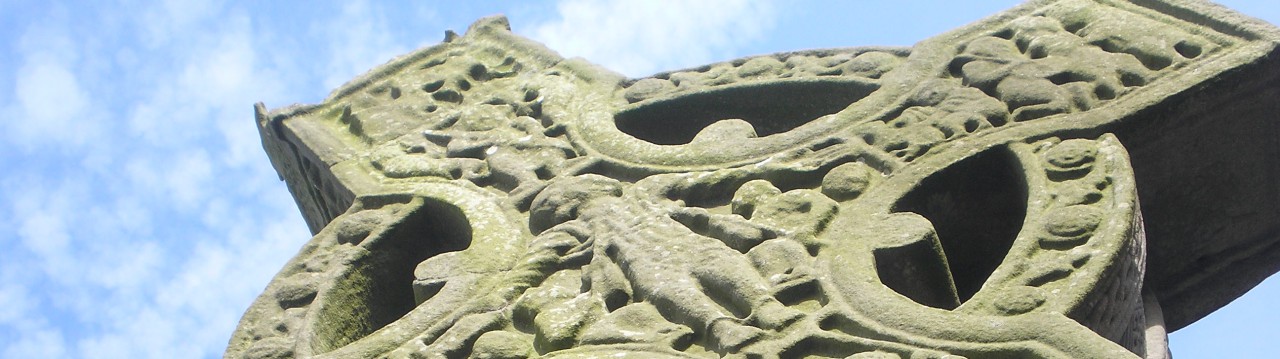
Image: Paul Joseph / Flickr (CC BY 2.0) [cropped]
Came across this little ditty last night: a poem by Aurelius Prudentius Clemens, a Christian Roman in the late 4th century AD. He apparently ended up as an ascetic…

NMS-0B5BB1: Roman finger ring
(PAS/Norfolk County Council CC-BY-SA)
I was very taken with the news yesterday of the recent recovery of a Roman silver disc near Swaffham, Norfolk. The disc (0.46 g, 11 mm) has been interpreted as a bezel and is thought to have been part of a finger ring. It also features ‘a diademed head engraved in intaglio’ with a ‘retrograde and somewhat garbled legend ANTONI VIVAS IN DEO’.
“The formula VIVAS IN DEO is a Christian one, the translation of this inscription being ‘Antonius, may you live in God‘. The fact that the letters are retrograde and engraved in intaglio would have made the bezel suited for use as a signet.”
Such an inscription dates the ring to sometime in the mid-late fourth/possibly early fifth century AD, making it a member of known, but relatively rare British examples of a personal object carrying overt Christian association. The formulaic vivas in deo on such rings has been previously interpreted as perhaps indicating gifts associated with Christian conversion or milestones in life.
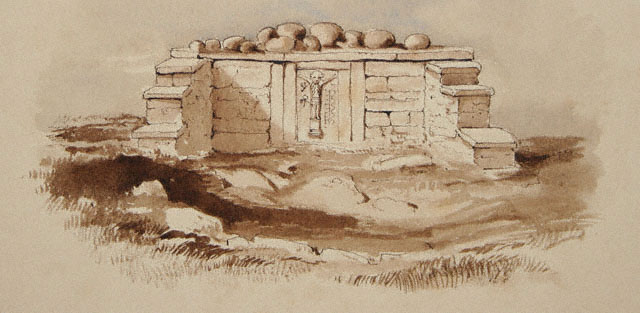
Wakeman’s 1895 sketch of St. Attracta’s Well, Clogher (Copyright Sligo County Library)
Seeing as today the feast day of a certain Irish St. Attracta, here’s a little something about her from Tírechán’s Collectanea which contains the earliest contemporary reference to her cult, a church site dedicated to her and a particular piece of geological info that amazingly still exists today…
A Long Tail – Image: Rafael Peñaloza/Flickr Commons (CC BY-NC-SA 2.0)
Last night I was reminded, via the Twitter Machine, of a great two-parter written by Christiaan Corlett – this time last year – entitled ‘Lughnasa at St Marcan’s Lough, Clew Bay, Co. Mayo’ (See Part 1 here and Part 2 here). St. Marcan’s Lough is the location of a medieval ecclesiastical site, now almost gone, on the shores of Clew Bay, Co. Mayo. Remains of possibly two churches and a leacht recorded in the 19th & 20th centuries, no longer survive. An altar and holy well (Tober Marcan) show some sign of partial preservation and a cairn/pilgrim station located on the loughs foreshore is still exposed at low tide. A Childrens Burial Ground is depicted in the vicinity along with a crannóg/platform within the Lough itself.
There is considerable Lughnasadh type folklore and traditions associated with the site, with a particular emphasis on cattle being driven in the waters of the lough, originally a freshwater lake (during the first week of August – as a curative or preventative protection/charm) in and around the cairn/monument and holy well. Corletts articles goes into great detail on this and he draws parallels with other similar traditions and accounts of horse/cattle rituals at other suspected Lughnasadh sites in the country.

Cover: Shaun Gallagher / The Columba Press
Introduction
There is hardly need to stress the historical importance of the figure & cult of St. Columba, long renowned as one of the three patron saints of Ireland who, alongside Brigid and Patrick, was elevated to such a position in the late seventh century AD. Like his co-patrons, his religious and cultural legacy continues to the present day. Brian Lacey, author of the latest book on the subject notes that of the three however, Columba offers us something almost unique. Patrick, whilst also a historical person nevertheless hailed from outside Ireland and the historical figure of Brigid, if there ever was a real person behind the myths and motifs remains out of reach in hazy obscurity. Columba (aka Colm Cille), the later of all three, offers us one of the earliest detectable insular Irish historical personages.
 vox hiberionacum