EMAP- Greatest Hits Vol 1: Now Thats What I Call Archaeology

885886_665258363545035_195922879323719923_o

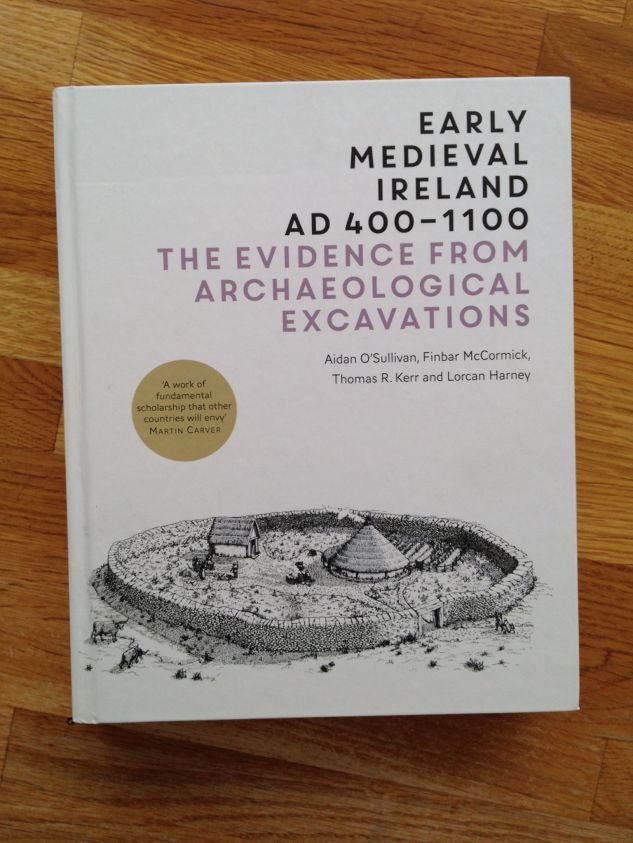
‘Early Medieval Ireland, AD 400-1100. The Evidence from Archaeological Excavations’.

A few days ago saw the official launch of what can only be described as the archaeo-bible for the next generation (and beyond) for scholars of Early Medieval Ireland. Essentially, it contains the most up to date survey, run-down and compilation of everything we thought we knew, everything we have learned, and everything we think we now know, arising from archaeological excavations (1930 to the present).  This is the latest offering from the Early Medieval Archaeology Project and is the product of several years of dedicated work and research.

Continue reading

‘Tlachta Be The Day’: Excavations at Tlachta, Co. Meath

Aerial View: Tlachta/Hill of Ward, Co. Meath (Bing Maps)

Here’s one to watch: today marks the beginning of a three week archaeological exploration of the late prehistoric multivallate enclosure site at Tlachta/Hill of Ward, Athboy, Co. Meath. The project is led by Dr. Steve Davis of UCD School of Archaeology and Cathy Moore (in addition to a cast of ‘thousands’) and is funded by the Royal Irish Academy, Meath Co. Council, the OPW and the Heritage Council. Steve has been conducting geophysical and computer aerial surveys of the site in recent years and the current project is the result of some very exciting and tantalizing indications arising from same.

Tlachta, considered to be an extremely high status ceremonial enclosure site, is mysterious in terms of its original function and purpose. It loomed large in the medieval political scene and plays a recurring role in myth, legend and dindsenchas (Place Name Lore) – including a dubious, but nevertheless intriguing association with ‘druids’ and Halloween (Samhain). These archaeological investigations are an historic first for the site and hold the prospect of finally answering some of the many questions we have concerning its origin, activity and probable augmentation over time.

Continue reading

Bealtaine: Mind the Gap

v
14780093236_d93e31a8c0_k.jpg

Image: Jan Mennens / Flickr (CC BY-NC-ND 2.0)

Bel(l)taine, aka May Day, aka the beginning of summer. Popularly held by many to be ‘Celtic’ and ‘Pagan’ and a whole lot of other stuff that it wasn’t and isn’t. Its earliest historical attestation comes from Early Medieval Ireland and up to quite recently, long held folklore traditions and customs continued in several parts of the country (as I write, the smell of smoke is drifting in the window from a nearby May Day bonfire).

The most common components of such traditions and associated folklore (and the ones which appear in the earliest references) involve fire, animal welfare/protection (especially cattle) in the hope of good yields to come – all hinting at the seasonal attributes and patterns involved in  medieval economies involving transhumance. There are of course many other traditions, but these are later manifestations in subsequent centuries. For the moment, I will stick with the basic version: Vanilla Bealtaine 1.0.

Continue reading

1014 and all that

0

Image: seriykotik1970/Flickr (CC BY-NC)

Today marks the 1000th anniversary of the death of Brian Boru at the Battle of Clontarf on 23rd April 1014 AD. You would have to have been hiding under a rock in deepest darkest Antarctica to have missed out on the plethora of associated festivities, events and commemorations that have been taking place in Ireland over the last few weeks. As an early medievalist, it was quite refreshing to see so much attention and interest in the media and public gaze. Some highlights include the wonderful TCDs ‘Emporer of the Irish’ Exhibition, History Hubs excellent video series on the background and legacy of the battle, the Irish Times heritage supplement on the subjects involved, the Contarf 1014 Exhibition in the National Museum and the TG4 documentary ‘Cluain Tarbh’ (still available on their online player).

Amongst all the the historical interpretation, contextualization, national & local promotion initiatives, educational endeavors, harnessing of tourism potential and – lets be honest – some blatant attempts to cash in on some sexed up horny Viking action; there has been little attention on an underlying historical consequence that (although unrealized at the time) would go on to have far reaching ramifications. And so, as we come to the end of the main commemoration, I thought I would throw my two cent into the larger Boruhaha.

Continue reading

The Price of Patrick: Fifteen Men (On a Deadmans Chest) [3]

5537697676_87b70febd3_z

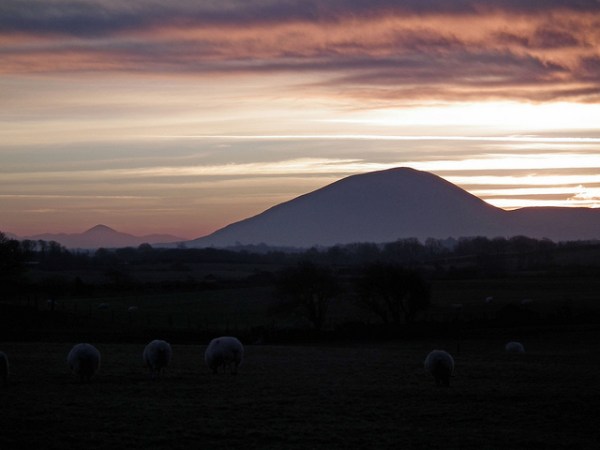
Nephin dwarfs Croagh Patrick in County Mayo – Image: Mayo.Me / Flickr / (CC BY-NC-SA 2.0)

<–Continued from Part Two

Show Me The Money

If Patrick indeed managed to establish himself in such a manner – as a publicly recognized high status figure (and related Christian ‘kindred’) within insular Irish society –  then he could have opened up an entirely different revenue stream quite apart from the previously mentioned gifts, offerings and even perhaps, any potential seed funding or external support from British Christian supporters.

As we have seen, in the later law tracts, a noble was entitled to receive his rightful portion of his clients shares and profits. As a Christian leader/Bishop Patrick would have likely expected occasional offerings from his more wealthy converts. As a ‘lord’ over ‘base clients’ however, he would have possibly been in a position to act as an initial seed funder himself – lending funds/goods/agricultural stock (on a favorable basis) to fledgling Christian clients in return for future shares/dividends/surplus. This in turn could have provided a regular ‘revenue stream’ to fund the expense of  his larger missionary efforts.

Quid pro quo – the more converts/clients brought in, the more revenue increases; the higher the increase in revenue, the higher the amounts he had to spend; the more he spent, the more  converts/clients he could bring in. Its essentially business marketing/localization 101 – early medieval Irish style. A self sustaining system, reliant on the flow of ‘funds’ from one level to the next.

Continue reading

The Price of Patrick: Fifteen Men (On a Deadmans Chest) [2]

Continued from Part One.

BiO1nEiIMAELBzI

So what could have the historical Patrick meant when he said that he paid out ‘the price of fifteen men/persons’? And what could that potentially tell us about early Irish Christian communities in fifth century Ireland?

Here’s the original passage again:

Uos autem experti estis quantum ego erogaui illis qui iudicabant per omnes regiones quos ego frequentius uisitabam. Censeo enim non minimum quam pretium quindecim hominum distribui illis, ita ut me fruamini et ego uobis semper fruar in Deum. Censeo enim non minimum quam pretium quindecim hominum distribui illis, ita ut me fruamini et ego uobis semper fruar in Deum. Non me paenitet nec satis est mihi: adhuc impendo et superimpendam; potens est Dominus ut det mihi postmodum ut meipsum impendar pro animabus uestris.

“You yourselves however, are not lacking in how much I expended/paid out to those who judge in all of the regions I visited often. I reckon/assess that I truly distributed a minimum worth/price/value of fifteen men…in order that you enjoy/have the benefit from me and that I always enjoy/have the benefit from you in God. I am not sorry, nor am I satiated, moreover I will still spend  and spend more besides, as long as I am able. God is powerful  and may yet grant/let me spend myself for your souls.”

Confessio 53 (My Trans.)

Continue reading

‘Out of the Mouths of Babes’: An Archaeology of the National Folklore Collection

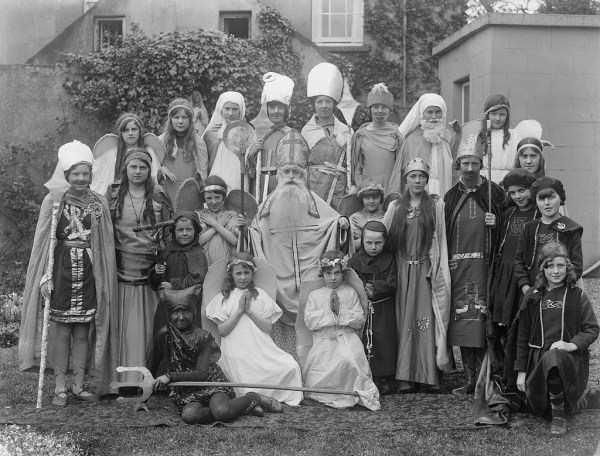
Schoolchildren, Waterford, 1932.

Image: National Library of Ireland / Flickr Commons (NLI Ref: P_WP_3910)

For the day that’s in it, I bring glorious tidings of a recently unveiled fantastic new historical & archaeological resource, wrapped up with a festive angle for good measure. Dúchas.ie is a new website of an incredible project (work in progress) which holds the long-awaited & venerable task of digitizing the National Folklore Collection of Ireland – ‘one of the largest folklore collections in the world’ – and ultimately making it available online for all. In the last two weeks, it has released its first fruits, 80% (c. 64,000 individual items) of handwritten folklore material from four counties in the Schools’ Folklore Collection (Dublin, Donegal, Mayo and Waterford) all beautifully digitized, readable, and zoomable on a clean, clear interface.

The Irish Folklore Collection is, quite simply, one of the nations greatest modern cultural treasures:

Continue reading