Pre-Christian Rock and Roll: St. Patrick’s Chair, Boheh, Co. Mayo

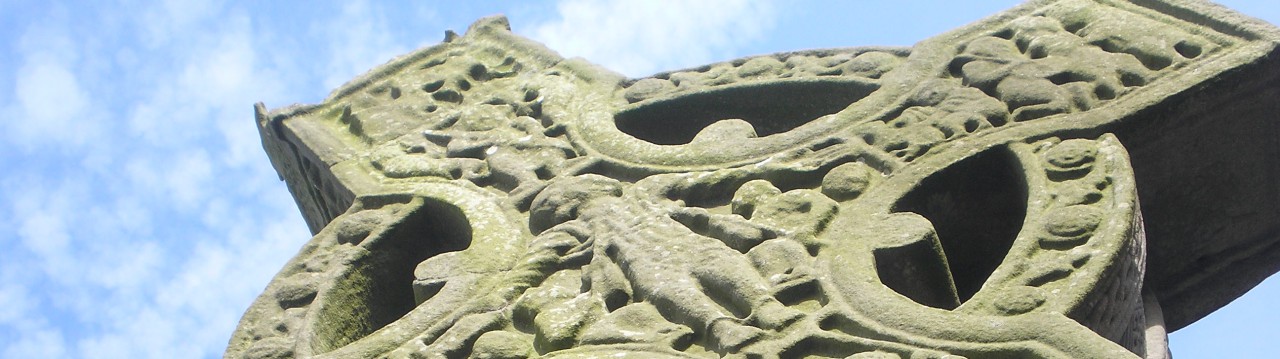
The townland of Boheh, Co. Mayo contains one of my favourite examples of outdoor prehistoric rock art in Ireland. Along a narrow side road, hidden away behind derelict housing and high hedgerows, lies a large natural outcrop of rock flecked with quartz strains, known as ‘St. Patrick’s Chair’. Upon its surface (spread out over 4 m2 ) over 250 individual petroglyphs are carved. They take the form of isolated ‘cup’, ‘cup and rings’ and ‘keyhole’ motifs (archaeological designations); and altogether form quite an impressive sight when viewed in the right seasonal and lighting conditions.

Both April 18th and August 24th are two such occasions.

Should you ever chance to find yourself at the site on either the above dates (weather permitting) you may be treated to the prehistoric equivalent of a ‘light show’. Standing at Boheh Rock/St. Patrick’s Chair on the dates above, looking west, the sun appears to set right on the peak of Croagh Patrick itself. Not only that, but it then subsequently appears, to an observer standing at Boheh ‘rock’, that the sun ‘rolls’ down the north side of the conical peak itself.

Continue reading

In the Name of Allah? Broaching Carolingian Connections at Ballycottin, Co. Cork

The British Museum’s Collection Database is a wonderful online resource containing over two million objects. It’s an incredible research tool in itself, for all periods and personages. Perhaps a lesser known aspect are some wonderful archaeological tidbits relating to finds from nineteenth century Ireland. Taking a virtual wander through the database one can stumble across some really intriguing objects, like this particular oddity from 1875; an early medieval Carolingian Brooch said to have been found in a bog at, or near, Ballycottin, Co. Cork.

AN00275809_001_l

Carolingian Brooch/Amulet (1875,1211.1) © The Trustees of the British Museum

Continue reading

Vox Hiberionacum: Patrick and the Voicing of Early Irish Identity [Part 2]

(Continued from Part One…)

‘The Britains’ and the ‘Britons’ in Patricks Writings

In his writings Patrick makes it clear that as someone whose homeland was in ‘the Britains’, he not only considered himself a foreigner in Ireland, but also that the people he  lived among were, in turn, considered foreigners/strangers from a Roman perspective: inter barbaras itaque gentes habito proselitus et profuga, ‘I live among barbarian foreigners, as a stranger and exile’ (Epist 1); ubi nunc paruitas mea esse uidetur inter alienigenas, ‘It was among foreigners that it was seen how little I was’ (Conf 1); denique seruus sum in Christo genti exterae, ‘Now, in Christ, I am a slave of a foreign people’ (Epist 10).

Continue reading

Vox Hiberionacum: Patrick and the Voicing of Early Irish Identity [Part 1]

irishOne of many interesting facets of Patrician history and hagiography is the role that the saint has played in the creation and maintenance of both religious and cultural identities throughout Ireland and the rest of the world. Due to the enigmatic nature of his writings and the wholesale absence of ‘fixed’ historical & geographical points within them; Patrick has always been seen as an everyman figure for anyone who wishes to claim him.

Various religious identities in Ireland and Scotland have, at one stage or another, claimed legitimacy and descent from a church allegedly founded by him (Some still do!). Irish emigration in the eighteenth & nineteenth centuries used him as a vehicle for the expression of both ethnic and martial identity abroad. Irish independence in the twentieth century and more recently, increasing devolution within the United Kingdom has resulted in even more cultural avenues that occasionally seek to reach out and connect with him across the centuries.

Allowing for over-simplification, its easy to see why: Patrick was a (fifth century) Briton, most likely from an area bordering modern-day Scotland; who grew up speaking a form of early Welsh (Brythonic); who then spent considerable time in Ireland, speaking Irish, and writing to fellow Christians elsewhere in Latin. To any modern-day audiences seeking to view him in such a light; the historical Patrick offers up the very epitome of an early medieval multicultural mongrel. Continue reading

The Cherry(mount) on the (Cheese)cake

I’m sure many people will already be aware of the ongoing exciting excavation of Cherrymount/Drumclay Crannóg, Co. Fermanagh. The site has featured heavily in the media over the last few months, and was the subject of much discussion within the archaeological community. For an in-dept rundown of the context and events surrounding its ‘discovery’, see a recent paper presented to the Institute of Archaeologists of Ireland by Seaver, M, O’Dowd, J & Chapple, R.M.; and  an article in the current issue of Archaeology Ireland, by Robert M. Chapple (he of the same blog page fame).

This coming Saturday (16th Feb) will see the second Open Day at Fermanagh County Museum, Enniskillen Castle Museums; where the public will have an opportunity to learn more about this wonderful site and its excavation. Continue reading

Nouissimis Diebus: St. Malachy the Irishman and the Last Days of Something or Other

The major news of the last day or so has been the surprise papal resignation announcement. Almost immediately, historic medieval precedents were being touted and referenced. The coming weeks will no doubt see a media surge of interest in medieval aspects of the modern-day Papacy/Vatican; and one of the more fanciful avenues will surely be the so-called ‘Prophecies of St. Malachy’. Allegedly penned by the twelfth century Irish reforming Bishop of Armagh, they purport to list over a hundred future popes with the current Pope occupying the second last position. The implication then, is that the coming Pope will be the last one.

mal brussels ms

St. Malachy, Brussels MS.II, 1167 (after Leclercq, 1959, 323)

As you can imagine, much ink and electronic typeface has already been spent on the subject, with a large majority of it occupying the very lowest level of armchair pseudo-historical quasi-mystical bovine excretia. In honour of the coming onslaught of idiotic internet babble concerning the Irish Malachy and his ‘prophecies’; I thought it would be appropriate to have a quick look at the figure of Malachy and what he actually represents in terms of Irish medieval history and archaeology. Continue reading

Knitting An Early Medieval Scottish ScARF

A Scotty Scarf!

Image: Jose M Vazquez (Flickr Commons)
Used under a CC Licence

If you are a scholar of Early Medieval Ireland, you are also a scholar of Early Medieval Scotland. We can’t begin to understand one, without viewing it in conjunction with the other. It’s that simple.

Ok, there’s also Early Medieval Britain, Wales, Norse Scandinavia, Merovingian & Carolingian Europe; but Early Medieval Scotland is really, really important. It occupied a central position between Ireland, Northumbria, Saxon & Norse Britain and onwards to Scandinavia. If the Irish and North Sea can be considered major medieval ‘highways’; then Scotland was possibly one of the biggest and most complicated medieval ‘cultural roundabouts’ of its day. Continue reading

No Horses for Courses: Christian Horror of Horseflesh in Early Medieval Ireland [Part 3]

3813930651_fe9511349a_z

Image: Tatum/Flickr (CC BY-NC-ND 2.0)

(Continued from Part 2…)

Straight from the Horses Mouth

Ultimately, what comes across from a (relatively!) brief survey of the range of archaeological, historical and etymological material are the following commonalities:

  • Widespread distribution of archaeological evidence for horse activity, iconography and ritual associated with high status figures and burials in late prehistoric Europe.
  • Widespread attestation of horse motifs, symbolism and metaphor associated with sacral and ancestral kingship/inauguration in late antiquity/early medieval Europe.
  • Widespread ecclesiastical condemnation of horseflesh and equine attributes in later medieval literature
  • Widespread ecclesiastical adaptation and transformation of horse/kingship motifs & traditions in sources pertaining to secular royal authority and legitimacy.

In terms of depicted pre-christian ritual associated with royal inauguration, certain motifs and cultural components appear frequently:

  • Outdoor assembly/meeting/burial locations
  • Public performance & display; power, authority, legitimacy
  • Horse/King sacral & symbolic union; association, attributes, metaphor
  • Horse sacrifice & consumption
  • Communal feasting and drinking
  • Large cauldrons/containers/receptacles to facilitate communal participation
  • Reiteration and renewal of royal/tribal prosperity and fortune

Continue reading

No Horses for Courses: Christian Horror of Horseflesh in Early Medieval Ireland [Part 2]

(Continued from Part 1…)

Heavy Horses: Armagh’s Stone Sculptures

If the horse/kingship motif can be detected in some of the earliest patrician hagiography depicting the foundation of Armagh; then the ecclesiastical centre itself also provides us with firm archaeological evidence of its survival and continuity throughout the later medieval period. Two strange medieval stone carvings are known from the area of the cathedral/church, both of which depict a human figure with horses ears. Thought to be a medieval sculptural representation of earlier Irish literature involving kingship figures, the stone sculptures have also been interpreted as an ecclesiastical re-working of insular tales modeled on the classical mythology of King Midas. Continue reading

No Horses for Courses: Christian Horror of Horseflesh in Early Medieval Ireland [Part 1]

6264429397_dd7783b9cf_o

No horses allowed! (Image: wallygrom / flickr / CC BY-SA 2.0)

This last week has seen much media attention and online mirth concerning the discovery of horse meat in certain high street beef products on sale throughout Ireland and the UK. For a good round-up of the initial reports, see Slugger O’Toole’s post here which contains the following quote from the Chief Executive of FSAI:

“In Ireland, it is not in our culture to eat horsemeat and therefore, we do not expect to find it in a burger…”

The concept of a deep-seated cultural and/or religious abhorrence of horse meat within modern Ireland and Britain struck me as extremely interesting. The disgust expressed in some quarters over the thought of inadvertently ingesting the same reminded me of certain historical and archaeological parallels within our shared cultural legacy.

As far back as the early medieval period, there are indications that both insular and European ecclesiastical authorities not only disapproved of the practice, but actively engaged in efforts to dissuade others from partaking of the same. So apparently successful was this early Christian disparagement, that todays cultural condemnation could perhaps be argued as not only being derived from an early medieval repugnance towards horseflesh consumption; but perhaps even, an underlying revulsion to what it may have represented to early Christian mindsets. Continue reading