Prancing at Lughnasa? St Marcan’s Lough, Mayo

5436708926_a9f329bf64_z

A Long Tail – Image: Rafael Peñaloza/Flickr Commons (CC BY-NC-SA 2.0)

Last night I was reminded, via the Twitter Machine, of a great two-parter written by Christiaan Corlett – this time last year – entitled ‘Lughnasa at St Marcan’s Lough, Clew Bay, Co. Mayo’ (See Part 1 here and Part 2 here). St. Marcan’s Lough is the location of a medieval ecclesiastical site, now almost gone, on the shores of Clew Bay, Co. Mayo. Remains of possibly two churches and a leacht  recorded in the 19th & 20th centuries, no longer survive. An altar and holy well (Tober Marcan) show some sign of partial preservation and a cairn/pilgrim station located on the loughs foreshore is still exposed at low tide. A Childrens Burial Ground is depicted in the vicinity along with a crannóg/platform within the Lough itself.

There is considerable Lughnasadh type folklore and traditions associated with the site, with a particular emphasis on cattle being driven in the waters of the lough, originally a freshwater lake (during the first week of August – as a curative or preventative protection/charm) in and around the cairn/monument and holy well. Corletts articles goes into great detail on this and he draws parallels with other similar traditions and accounts of horse/cattle rituals at other suspected Lughnasadh sites in the country.

Continue reading

Review: Saint Columba: His Life & Legacy

Columba Life & Legacy

Cover: Shaun Gallagher / The Columba Press

Brian Lacey, Saint Columba: His Life & Legacy. Dublin: The Columba Press. June, 2013. ISBN: 9781-85607-879-5.  7 + 224 pp.

Introduction

There is hardly need to stress the historical importance of the figure & cult of St. Columba, long renowned as one of the three patron saints of Ireland who, alongside Brigid and Patrick, was elevated to such a position in the late seventh century AD. Like his co-patrons, his religious and cultural legacy continues to the present day. Brian Lacey, author of the latest book on the subject notes that of the three however, Columba offers us something almost unique. Patrick, whilst also a historical person nevertheless hailed from outside Ireland and the historical figure of Brigid, if there ever was a real person behind the myths and motifs remains out of reach in hazy obscurity. Columba (aka Colm Cille), the later of all three, offers us one of the earliest detectable insular Irish historical personages.

Continue reading

Ad Solis Victi Hibernicum: To the Conquered Irish Sun

IMAG0434

Setting Sun, Atlantic Ocean, Ireland (Image: Author)

Seeing as today is the summer solstice in the northern hemisphere, I thought I’d share the earliest contemporary historical reference to pagan Irish sun-worship which is found within Patrick’s Confessio, written sometime in the fifth century AD. It occurs at the very climax of the document as Patrick is signing off and declaring his deep Christian faith and belief in his ‘children of the living God and co-heirs of Christ’…

Continue reading

Rapunzel, Rapunzel, Let Down Your Hair: Rappelling Round Towers in Medieval Ireland

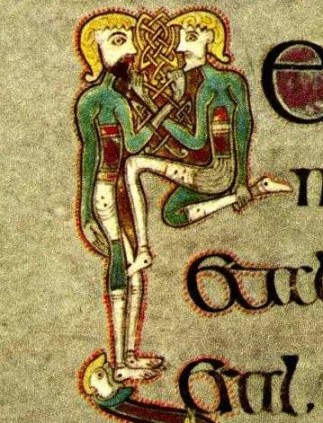
kells 253vThis is just a brief little ditty thrown together in haste –  in reply to a recent highly entertaining and thoughtful blog post by Robert M Chapple: ‘George and the Giant Archaeological Theory’. In it, he implies (somewhat alarmingly) that a) I am level-headed (slander, your honour!) and b) that I may somehow know something about monastic ‘rope-ladders’ in Ireland.
Sadly, I have yet to come across anything tangible involving rope ladders in either archaeology or hagiography, something which is only slightly lessened by my absolute devastation at the lack of early medieval pole vaulting evidence. (Confused? Read the original post.)

Continue reading

OMG: Ogam in 3D – Exciting New Database from Dublin Institute for Advanced Studies

102107426_b3cd240e84

Ogham, Aghadoe, County Kerry.
Image: Jeremy Keith/Flickr Commons
(Used under a CC Licence)

A long-awaited and very exciting resource: the new online database ‘Ogham in 3D’ from Dublin Institute for Advanced Studies is coming shortly. Its already online with a small selection (50+) of individual stones. The site is going to offer 3D scans of Irish Ogham stones, alongside their associated historical, etymological and archaeological data; ‘bringing all of the available information together in a single searchable archive’.

In other words, a GOLDMINE for researchers. Really. You have no idea how disparate a lot of this information has previously been.

Ogham stones are crucial to understanding the development of Early Irish Christianity. Not only are the inscriptions the earliest recorded efforts at replicating the aural sounds of primitive Irish; but as formulaic monumental inscriptions involving named ancestral figures, they are quite possibly the earliest archaeological evidence for Insular Irish Christianity itself. Continue reading

Blood from a Stone: some half drawn thoughts on Bullauns

IMAG1050_Sophia1_vox-hib

‘Blood from a stone’ (Image: Author)

A while back, I was sniffing around the site of an old medieval parish church in Kilnamanagh, Co. Roscommon (not much remains) when I caught sight of an old stone ‘stoup’, or font, placed into the surrounding graveyard wall. It’s not medieval, probably 18/19th cent, but it nevertheless reminded me of medieval bullaun stones; hemispherical cup-shaped depressions hollowed out of rocks and very much associated with medieval ecclesiastical sites and pilgrim routes.

The crucifix that had been placed inside was plastic and coated with metallic paint, probably a fragment from a temporary grave marker. Being there a while, the metal had obviously undergone some sort of rust/oxidation chemical process. As a result, the water within had turned a wonderful blood-red colour, resulting in a very evocative image.     Continue reading

Pre-Christian Rock and Roll: St. Patrick’s Chair, Boheh, Co. Mayo

The townland of Boheh, Co. Mayo contains one of my favourite examples of outdoor prehistoric rock art in Ireland. Along a narrow side road, hidden away behind derelict housing and high hedgerows, lies a large natural outcrop of rock flecked with quartz strains, known as ‘St. Patrick’s Chair’. Upon its surface (spread out over 4 m2 ) over 250 individual petroglyphs are carved. They take the form of isolated ‘cup’, ‘cup and rings’ and ‘keyhole’ motifs (archaeological designations); and altogether form quite an impressive sight when viewed in the right seasonal and lighting conditions.

Both April 18th and August 24th are two such occasions.

Should you ever chance to find yourself at the site on either the above dates (weather permitting) you may be treated to the prehistoric equivalent of a ‘light show’. Standing at Boheh Rock/St. Patrick’s Chair on the dates above, looking west, the sun appears to set right on the peak of Croagh Patrick itself. Not only that, but it then subsequently appears, to an observer standing at Boheh ‘rock’, that the sun ‘rolls’ down the north side of the conical peak itself.

Continue reading

Vox Hiberionacum: Patrick and the Voicing of Early Irish Identity [Part 2]

(Continued from Part One…)

‘The Britains’ and the ‘Britons’ in Patricks Writings

In his writings Patrick makes it clear that as someone whose homeland was in ‘the Britains’, he not only considered himself a foreigner in Ireland, but also that the people he  lived among were, in turn, considered foreigners/strangers from a Roman perspective: inter barbaras itaque gentes habito proselitus et profuga, ‘I live among barbarian foreigners, as a stranger and exile’ (Epist 1); ubi nunc paruitas mea esse uidetur inter alienigenas, ‘It was among foreigners that it was seen how little I was’ (Conf 1); denique seruus sum in Christo genti exterae, ‘Now, in Christ, I am a slave of a foreign people’ (Epist 10).

Continue reading

The Cherry(mount) on the (Cheese)cake

I’m sure many people will already be aware of the ongoing exciting excavation of Cherrymount/Drumclay Crannóg, Co. Fermanagh. The site has featured heavily in the media over the last few months, and was the subject of much discussion within the archaeological community. For an in-dept rundown of the context and events surrounding its ‘discovery’, see a recent paper presented to the Institute of Archaeologists of Ireland by Seaver, M, O’Dowd, J & Chapple, R.M.; and  an article in the current issue of Archaeology Ireland, by Robert M. Chapple (he of the same blog page fame).

This coming Saturday (16th Feb) will see the second Open Day at Fermanagh County Museum, Enniskillen Castle Museums; where the public will have an opportunity to learn more about this wonderful site and its excavation. Continue reading

A Quirky Case of Early Medieval Ecclesiastical Propaganda [Part 2]

(Continued from Part 1)

My last post examined a recent reference to early medieval hagiographical material by modern ecclesiastical figures. Divorced from its original setting and ecclesiastical milieu, the episode in question ended up losing much of its intended meaning by being ‘lost in translation’ on many levels. A particular irony was that, in attempting to emphasize the historical nature of a recent ordination, the uncritical use of hagiography as ‘history’ inadvertently served to underplay the actual historical and archaeological importance of the original ecclesiastical site of Fuerty, Co. Roscommon.

So what we can say or surmise from the seventh century reference to Fuerty by Tírechán? Continue reading